ここから本文です
TWO:

Hydrocyclone (liquid cyclone)01

Hydrocyclone (liquid cyclone)02

A hydrocyclone (liquid cyclone) injects treatment solution into stationary equipment to perform separation, classification, and concentration, and is an innovative separator with a very simple structure and no drive unit.

Structure of a hydrocyclone (liquid cyclone)

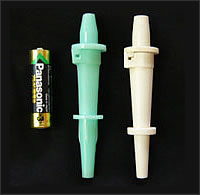
A suspension containing fine particles of several micrometers or more is supplied to a cylindrical container circumferentially at high speed. And as a result it starts to rotate and a centrifugal force is generated. At this time a gravitational acceleration of several tens of thousands of G is generated in the circumferential direction, and thus leading to fast sedimentation and concentration of the fine particles. The separated concentration can be freely selected by changing the supply rate (supply pressure and flow rate) and the flow ratio of the outlet. Our hydrocyclone (liquid cyclone) was designed and manufactured to classify and concentrate fine particles, and so has a small element.

THREE:Mackintosh, who was a young lawyer of excellent education, but yet entirely unknown, this year published his "Vindici? Gallic?," in reply to Burke; but he did it with the behaviour of a gentleman, and evident admiration of the genius and political services of the great man whom he opposed. His book was immensely admired, and at once lifted him into notice. But it was not long before he began to see the correctness of Burke's views and prophecies as to the French Revolution, and he did not shrink from avowing the change of his sentiments in the Monthly Review and in conversation. His talents and this alteration of his views recommended him to the Ministers, and he was appointed by Pitt and Loughborough a professor of Lincoln's Inn, where, in a course of lectures on the Constitution of England, he exhibited himself as an uncompromising censor of the doctrines he had approved in his "Vindici? Gallic?." For this he was classed, by the vehement worshippers of French ideas, with Burke, as a venal turncoat. Mackintosh did not content himself with recanting his opinions on this topic from the platform and the press; he wrote directly to Burke, who was now fast sinking under his labours and his disappointments, and expressed his undisguised admiration of his sagacity as a politician, and of his general principles and political philosophy. Burke invited him down to Beaconsfield, where a closer view of the philosopher and orator greatly increased his esteem and admiration of the man.Napoleon Buonaparte, who had appeared so anxious for peace with Britain, was, in truth, greatly rejoiced at the rejection of his proposals, for it furnished him with the pleas which he desired, for the still more extended schemes of military ambition that he entertained. He issued a proclamation complaining of the obstinate hostility of Britain, and called on the people to furnish men and arms to conquer peace by force. Having placed Moreau at the head of the army on the Rhine, Buonaparte prepared for his favourite project of reconquering Italy. He had judged right in sending Moreau to Germany, who took care to prevent the Austrians from sending reinforcements to Italy to increase Buonaparte's difficulties; and another circumstance, most auspicious to the Chief Consul, was the fact that Paul of Russia, offended at the Austrians for not better supporting his generals, Korsakoff and Suvaroff, had withdrawn his army from the campaign. The Austrians, under Mlas, in the north of Italy, amounted to one hundred and forty thousand men. They had spent the winter on the plains of Piedmont, and contemplated, in the spring, reducing Genoa, by assistance from the British fleet, and then, penetrating into Provence, to join the Royalists there, ready to take arms under Generals Willot and Pichegru. Massena, freed by the retreat of the Russians from his confinement at Zurich, lay, with an army of forty thousand, between Genoa and the Var; but his troops had suffered great distress from want of provisions, and whole regiments had abandoned their posts, and, with drums beating and colours flying, had marched back into France. Buonaparte first arrested their desertion by several stirring appeals to the soldiers, and then prepared to march with a strong army of reserve through the Alps, and to take Mlas unexpectedly in the rear. To effect this it was necessary to deceive the Austrians as to his intentions; and for this purpose he assembled a pretended army of reserve at Dijon, as if meaning to obstruct the march of the Austrians southward. To favour the delusion, Buonaparte went to Dijon, and reviewed the pretended army of reserve with much display, he then got quietly away to Lausanne, and pushed across the Great St. Bernard, amidst incredible difficulties.
  • Equipment costs can be reduced.
  • Operating costs can be reduced.
  • Maintenance costs can be reduced.
  • Any change in raw material and product can be easily addressed.
  • Large amounts can be treated in a small area.
  • Separation and cleaning are easy because of the simple structure.
  • Simplified control
  • This equipment can be operated in synchronization with external devices.
  • Alarm and interlock mechanism.
THREE:
  • Classification and concentration for the manufacture of inorganic powder materials
  • Classification of ceramic materials
  • Removal of fine particles, including iron powder
  • Removal of fine particles from pigments
  • Removal of fine organic particles from solvents
  • Separation of starch and yeast
  • Removal of fine particles from high-temperature strong acid solutions
  • Removal of fine particles from low-temperature solutions